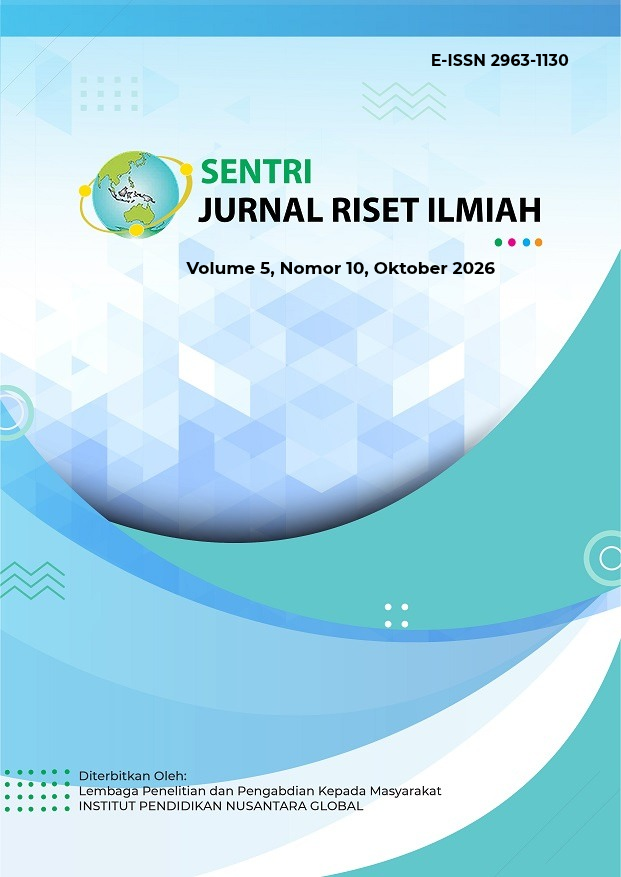
Rancangan Konseptual Model Pembelajaran Menulis Cerpen Berbasis Story Cube Dan Project-Based Learning Dalam Perspektif Pragmatisme John Dewey
DOI:
https://doi.org/10.55681/sentri.v5i10.7401Keywords:
Cube, Project-Based Learning, Short Story Writing, Pragmatism, John DeweyAbstract
Short story writing instruction still faces difficulties in generating initial ideas, developing plots, and starting stories, as learning tends to emphasize final products and theoretical understanding. Studies on Story Cube have mostly focused on procedures and effectiveness at the primary and Islamic junior high school levels, while its philosophical foundation has received little attention. This article aims to formulate a conceptual design of a short story writing learning model based on Story Cube through Project-Based Learning (PjBL) and to analyze its foundation in John Dewey’s pragmatism. The study employs a qualitative approach with a philosophical library research design. Primary sources are Dewey’s works, while secondary sources are literature on pragmatism in education, the creative process, short story writing instruction, and Story Cube and PjBL. Data were analyzed through content analysis and hermeneutic interpretation. The study yields a six-stage model design: experience trigger, project planning, drafting, peer editing, publication, and reflection. Dewey’s foundation appears in four aspects: Story Cube as a trigger of concrete experience, short story writing as reconstruction of experience and aesthetic expression, PjBL as a vehicle for learning by doing and social interaction, and reflection as inquiry that maintains the continuity of experience. Conceptually, the random stimulus of Story Cube becomes educative only when it is connected to students’ personal experience and guided from play toward purposeful creative work. The design has not been validated by experts or tested empirically; validation may be pursued through development.
Downloads
References
Adnan, A., Setiawan, F., & Naila, I. (2023). Penerapan model project-based learning (PjBL) pada pembelajaran penulisan cerpen kelas VI SD Muhammadiyah 26 Surabaya. Inovasi Sekolah Dasar: Jurnal Kajian Pengembangan Pendidikan, 10(1), 26–33. https://doi.org/10.36706/jisd.v10i1.20053
Ahmadi, A. (2020). Menulis mandiri konteks sastra dan psikologi (A. Kurniawan, Ed.). Penerbit Graniti.
Andriani, I., Musaddat, S., & Syarifuddin. (2026). Pengaruh penggunaan media Story Cube berbasis teks narasi terhadap membaca pemahaman siswa kelas IV SDN 24 Cakranegara. Jurnal Pendidikan, Sains, Geologi, dan Geofisika (GeoScienceEd Journal), 7(3), 3871–3878. https://doi.org/10.29303/goescienceed.v7i3.2491
Badan Standar, Kurikulum, dan Asesmen Pendidikan. (2025). Keputusan Kepala BSKAP Nomor 046/H/KR/2025 tentang Capaian Pembelajaran pada Pendidikan Anak Usia Dini, Jenjang Pendidikan Dasar, dan Jenjang Pendidikan Menengah. Kementerian Pendidikan Dasar dan Menengah. https://bpmpbabel.kemendikdasmen.go.id/PPID/wp content/uploads/2025/07/KepKaBSKAP-046_2025-ttg-CP.pdf
Bakker, A., & Zubair, A. C. (1990). Metodologi penelitian filsafat. Kanisius.
Br Barus, E., Dito Meliala, H., & Telaumbanua, V. V. (2023). Upaya meningkatkan keterampilan menulis cerpen dengan menerapkan metode pembelajaran project based learning siswa SMA swasta GBKP Kabanjahe. Jurnal Penelitian Pendidikan Bahasa dan Sastra, 8(2). https://jurnal-lp2m.umnaw.ac.id/index.php/JP2BS/article/download/4812/2127
Chen, M.-H. (2017). The formative role of art: John Dewey’s art as quotidian experience. Journal of Literature and Art Studies, 7(12). https://doi.org/10.17265/2159-5836/2017.12.010
Dewey, J. (1916). Democracy and education. Macmillan.
Dewey, J. (1933). How we think (Rev. ed.). D. C. Heath.
Dewey, J. (1934). Art as experience. Minton, Balch & Company.
Dewey, J. (1938). Experience and education. Macmillan.
Efendi Pohan, J., & Br Sembiring, Y. (2024). Pengaruh model pembelajaran project based learning terhadap keterampilan menulis teks cerita pendek pada siswa. Jurnal Educatio, 10(3), 1008–1014. https://doi.org/10.31949/educatio.v10i3.9406
Flower, L., & Hayes, J. R. (1981). A cognitive process theory of writing. College Composition and Communication, 32(4), 365–387.
Gadamer, H.-G. (2004). Truth and method (2nd rev. ed.; J. Weinsheimer & D. G. Marshall, Trans.). Continuum. (Original work published 1960)
Grierson, E. M. (2017). Re-imagining learning through art as experience: An aesthetic approach to education for life. Educational Philosophy and Theory, 49(13). https://doi.org/10.1080/00131857.2017.1284037
Hanes, J. M., & Weisman, E. (2016). Experience and expression. Education and Culture, 32(2). https://doi.org/10.7771/1559-1786.1619
Hanifah, R., Djuanda, D., & Gusrayani, D. (2026). Pengembangan media berbasis Google Sites berbantuan dadu bercerita untuk pembelajaran menulis teks cerpen kelas V SD. JGK (Jurnal Guru Kita), 10(3). https://doi.org/10.24114/jgk.v10i3.75079
Husniati, W. O., Dinar, S. S., Tike, L., & Rifai’e, M. (2025). Faktor kesulitan belajar siswa pada pembelajaran menulis cerpen kelas IX. Jurnal Bastra (Bahasa dan Sastra), 10(4), https://doi.org/10.36709/bastra.v10i4.1280
Jackson, P. W. (1998). John Dewey and the lessons of art. Yale University Press.
Khairunnisa, S., & Devianty, R. (2026). Pengembangan media Story Dice berbasis gamifikasi untuk kemampuan kreativitas menulis cerpen. Dialektika, 13(2), 1–19. https://doi.org/10.15408/dialektika.v13i2.51245
Downloads
Published
How to Cite
Issue
Section
License
Copyright (c) 2026 Susiati Pamungkas, Anas Ahmadi

This work is licensed under a Creative Commons Attribution-ShareAlike 4.0 International License.