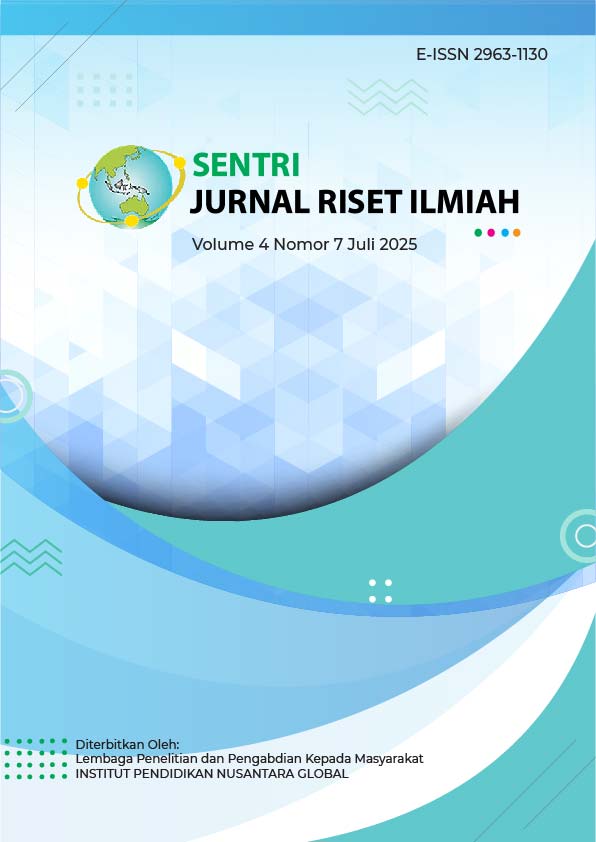
Peran Self-Regulated Learning Sebagai Mediator Dalam Hubungan Self-Efficacy dan Prokrastinasi Akademik pada Mahasiswa
DOI:
https://doi.org/10.55681/sentri.v4i7.4299Keywords:
Self-Efficacy, Self-Regulated Learning, Academic Procrastination, StudentAbstract
To reduce academic procrastination, students need confidence in their ability to face problems and take the actions needed to complete tasks to get the expected results. Solomon and Rothblum (1984) define academic procrastination as the postponement of important academic tasks, such as preparing for exams, completing assignments, taking care of university administration and attending classes. To reduce academic procrastination, self-efficacy is needed to cope with problems and take the necessary steps to complete the task and achieve the desired results (Bandura, 1997). In their research, Klassen et al (2008) found that low self-regulatory self-efficacy predicts high academic procrastination. Individuals with low self-regulatory learning tend to procrastinate, as self-regulatory ability is an important factor affecting the emergence of procrastination behavior in students (Steel, 2007). The results of this study show that self-regulated learning has an important role that is negative, with the understanding that the large role of self-regulated learning has an impact on reducing the level of academic procrastination, and the low role of self-regulated learning has an impact on increasing academic procrastination.
Downloads
References
Artino Jr, A. R. (2009) Are view of the motivated strategies for learning questionnaire. Thesis. University of Connecticut.
Bandura, A. (1997) Self Efficacy: the exercise of control. New York: W. H. Freeman and Company.
Bosscher, R.J. & Smit, J.H. (1998). Confirmatory faktor analysis of the General Self-Efficacy Scale. Behavior Research and Therapy, 36,339-343.
Budiastuti, Dyah dan Agustinus Bandur. (2018). Validitas Dan Reliabilitas Penelitian Dengan Analisis dengan NVIVO, SPSS dan AMOS. Jakarta: Mitra Wacana Media.
Chotimah, C., & Nurmufida, L. (2020). Pengaruh Self-Regulated Learning Dan Pola Asuh Orang Tua Terhadap Prokrastinasi Akademik Mahasiswa. Journal Manajemen Pendidikan Islam, 5(1), 55–65.
Eddy Roflin. (2021). Populasi, Sampel, Variabel Dalam Penelitian Kedokteran. Pekalongan - Jawa Tengah: PT. Nasya Expanding.
Ferrari, Josef, R; Johnson & Mccown (1995). Procrastination and task avoidance: Theory, research and treatment. New York: lenum press.
Jayusman Iyus dan Shavab O.A.K. (2020). Studi Deskriptif Kuantitatif Tentang Aktivitas Belajar Mahasiswa Dengan Menggunakan Media Pembelajaran Edmodo Dalam Pembelajaran Sejarah. Jurnal Artefak: Vol.7 No.1 April 2020 [1]
Kandemir, M., (2014). “Reasons of Academic Procrastination: Self-regulation, Academic, Self-efficacy, Life Satisfaction and Demograpics Variabel”. Procedia Social and Behavioral Sciences, 152, 2014,188–193. https://doi:10.1016/j.sbspro.2014. 09.179
Klassen, R. M., Krawchuk, L. L., & Rajani, S. (2008). Academic procrastination of undergraduates: Low self-efficacy to self-regulate predicts higher levels of procrastination. Contemporary Educational Psychology, 33, 915-931. https://doi:10.1016/j.cedpsych.2007.07.001.
Knaus, W. (2000). “Procrastination, Blame, and Change”. Journal of Social Behavior & Personality, 15(5), 2000, 153-16
Knaus, W. (2002). The Procrastination Woorkbook. American: New Herbinger
Pintrich, P. R., Smith, D. A. F., & Mckeachie, W. J. (1993). Reliability and Prediktive Validity of the Motivated Strategies for Learning Questionnaire (MsLq), Educational and Psychological Measurement, 53: 801-813.
Santrock, John W. (2020). Life-Span Development (10th – International Student Edition). New York: McGraw-Hill
Sherer, M., Maddux,J.E., Mercadante, B., Prentice- Dunn, S., Jacobs, B., & Rogers, R.W., (1982). The Self-Efficacy Scale. Construction and Validation Psychological Reports, (51), 663-667.
Solomon, L. J., dan Rothblum, E. J. (1984). Academic procrastination: Frequency and cognitive behavioral correlates. Journal of Counseling Psychology, 31, 503-509. https://doi:10.1037/0022-0167.31.4.503
Steel, P. (2007). The nature of procrastination: A meta-analytic and theoretical review of quintessential self-regulatory failure. Psychological Bulletin, 133(1), 65–94. https://doi.org/10.1037/0033-2909.133.1.65
Steel, P. , & K. K. B. (2016). Academic procrastination: psychological antecedents revisited. Australian Psychologist, 51(1), 36–46. https://doi.org/10.1111/ap.12173
Syafiqa, Najla. (2021). Hubungan Self-Regulated Learning Terhadap Prokrastinasi Akademik Mahasiswa dalam Perkuliahan Daring Masa Pandemi Covid-19. Skripsi. Malang: Universitas Muhammadiyah Malang.
Vardia, M. A., & Kamilah, N. F. (2023). Hubungan antara Efikasi Diri dengan Problem-Solving dalam Mengerjakan Skripsi Mahasiswa Psikologi Universitas Islam Raden Rahmat. Flourishing Journal, 2(7). https://doi.org/10.17977/um070v2i72022p522-528
Wahyuningsih, N. K. A. T., Manangkot, M. V., & Rahajeng, I. M. (2022). Hubungan dukungan sosial teman sebaya dengan prokrastinasi akademik pada mahasiswa keperawatan. Coping: Community of Publishing in Nursing, 10(1), 109. https://doi.org/10.24843/coping.2022.v10.i01.p14
Widyaningrum, R. , & S. T. (2021). Hubungan Antara Kontrol Diri dan Efikasi Diri Dengan Prokrastinasi Akademik Pada Siswa Kelas XI SMAIT Raflesia Depok. Jurnal IKRA-ITH Humaniora, 5(2), 1–6.
Wolters, C. A. (2003). Understanding Procrastination from a Selfregulated Learning Perspective. Journal of Educational Psychology, 95, 179 –187.
Woodruff, S. I. & Cashman, J. F. (1993). Task, Domain, and General Self-efficacay: A Reexamination of The Self-effiacy Scale. Psychological Reposrts, 72, 423-432 https://doi.org/10.2466/pr0.1993.72.2.423
Wulandari, M. , & M. S. E. (2020). Pengaruh efikasi diri dan kontrol diri terhadap prokrastinasi akademik pada mahasiswa universitas 17 Agustus 1945 Samarinda. Motiva: Jurnal Psikologi, 3(1), 35–443.
Zimmerman, B.J. (1989). A Social Cognitive View of Self-Regulated Academic Learning. Journal of Educational Psychology,. 81, (3), 329-339
Zimmerman, B. J., & Schunk, D. H. (Eds.). (2004). Handbook of self-regulation of learning and performance. Routledge/Taylor & Francis Group.
Downloads
Published
How to Cite
Issue
Section
License
Copyright (c) 2025 Maria Yuni Megarini Cahyono, Meilani Rohinsa, Trisa Genia C. Zega

This work is licensed under a Creative Commons Attribution-ShareAlike 4.0 International License.